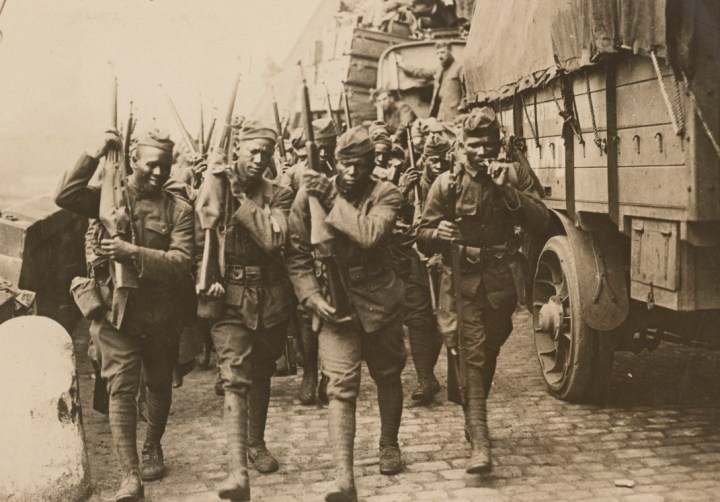
[/audio]
September 3, 1918
My Dear Mr Brimley,
… I am glad to know that my people are doing their bit to win the war, they sure make good soldiers and seem to take delight in sticking Fritz with a bayonet or clubbing him with the butt end of a rifle, but their main weapon is the hand grenade…
I am writing to the new commander today asking for special duty as patrol officer and I hope I can get it as it affords a fellow a better chance for promotion and excitement all his own and then I have a score to pay Fritz for leaving a scar on my face, and I want to get him where I can fix him to my own taste. My best regards to Mrs Brimley … and all my friends, and write when you have the time to.
Yours very respectfully,
James W Alston
While the majority of black soldiers serving in World War I were assigned to non-combat jobs such as loading and unloading cargo ships, and burying the dead, soldiers in the 93rdDivision did see combat. This division included Alston’s, as well as the 369th Infantry Regiment, also known as the Harlem Hellfighters. Henry Johnson and Needham Roberts of that regiment were the first Americans of any race to receive France’s Croix de Guerre. The Stuff You Missed in History podcast has a very informative episode about the Harlem Hellfighters.
Alston’s letters, as well as other primary sources pertaining to African American soldiers in WWI, are at the Digital Public Library of America.
Other Sources
“World War I: African-American Soldiers Battle More than Enemy Forces,” Library of Congress
“One Hundred Years Ago, the Harlem Hellfighters Bravely Led the US into WWI,” Smithsonian Magazine
“African-American WWI ‘Harlem Hell Fighters’ Proved their mettle, Patriotism in Combat,” U.S. Army
Official History of the American Negro in the World War, W. Allison Sweeney
 American Epistles